
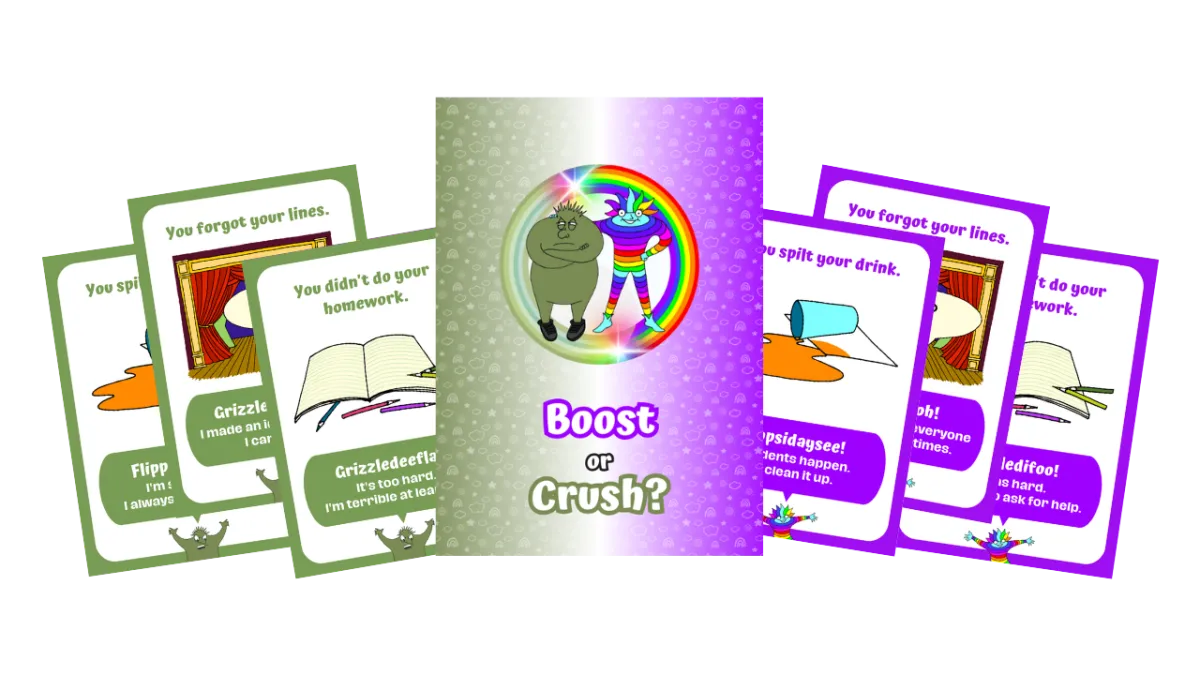
Boost or Crush? Matching Game for Educators
Step 1: Group Players
Divide students into small groups—either pairs or groups of four.
Step 2: Select Level
Choose the beginner or intermediate level based on their age.
Step 3: Set Up Cards
Lay out pairs of cards for each group to play with.
Step 4: Match Cards
Players take turns picking two cards. If the cards match, discuss Crusher or Booster.
Step 4.1: Discuss Crusher
Each player answers,
“What would your Crusher say in this situation?”
Step 4.2: Discuss Booster
Each player answers,
“What would your Booster say in this situation?”
Step 5: Play Until Completion
Continue until all cards are matched or the time limit is reached.
Step 6: Extension Activity
Ask groups to share what they learned and how they feel.
Matching Game for Guided 1:1 Plays
Step 1: Set Up
Play one-on-one with a supportive adult, such as a teacher, teaching assistant, or counselor, and a child who may be struggling with learning, behavior, friendships, or perfectionism.
Step 2: Encourage Self-Inquiry
Guide the child to be their own detective, exploring how their Crusher Voice and Booster Voice would respond to different situations.
Step 3: Play the Game
Take turns picking two cards. If the cards match, discuss the Crusher or Booster voice.
Step 4: Deepen the Conversation
Spend time listening and discussing how the Crusher Voice might affect the child’s feelings, behavior, or confidence.
Step 5: Normalize the Experience
Share your own Crusher and Booster examples to help the child see they are not alone in their thoughts. Use phrases like “Me too!” when you relate to their feelings or experiences.
Step 6: Reassure and Empower
Remind the child that everyone has a Crusher Voice, but they have the power to turn down its volume and amplify their Booster Voice.
Step 1: Create Personalized Scenarios
Once the child is comfortable with the game, work together to come up with scenarios that are specific and relevant to their experiences.
Step 2: Design Your Own Cards
Draw or write the scenarios on cards.Add fun, silly expletives (e.g., “Flippadeeflip!”) to make the process playful and engaging.Use green cards for Crusher scenarios and purple cards for Booster responses.
Step 3: Capture the Child’s Words
Write down the child’s exact words, verbatim if possible, when they describe their Crusher and Booster voices.
Step 4: Keep the Atmosphere Light
Use humor, funny voices, or exaggerated facial expressions to diffuse any tension.Make the process fun and enjoyable to help the child feel safe and at ease.
Step 5: Reinforce the Booster Voice
Discuss ways to "turn up the volume" on their Booster voice.Empower the child by reminding them they hold the "remote control" for their thoughts.
Making the Invisible, Visible!
"The Voices in My Head!" explores how our internal dialogues shape emotions and behaviors. Use these starting points to foster mindful awareness, emotional intelligence, and self-compassion in your children. Download our free guide: Top Tips for Nurturing Young Minds